



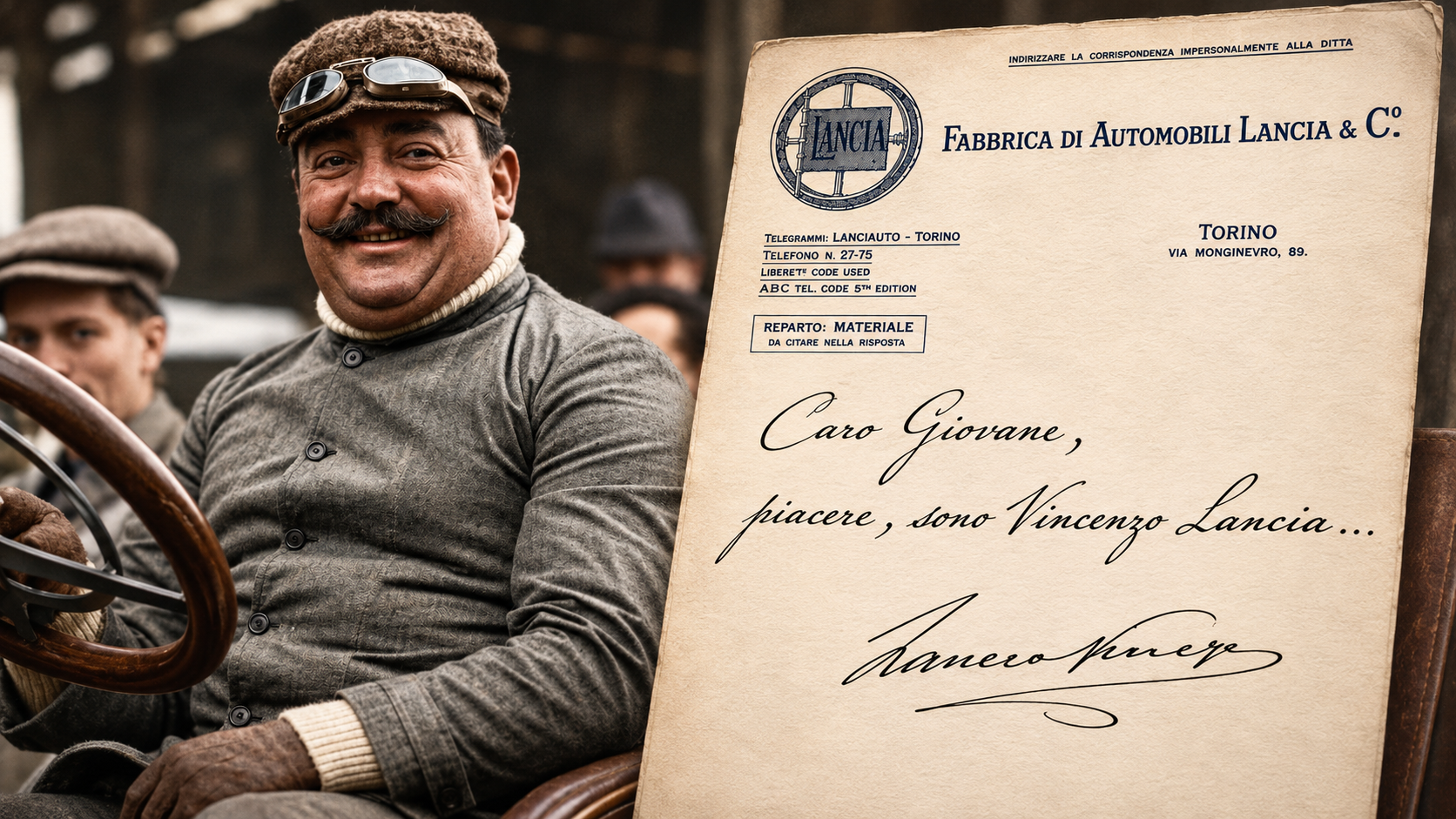
On the 120th anniversary of the founding of Lancia, we wanted to mark the occasion a little differently. Rather than retrace the history of the marque through its cars, technological firsts and sporting victories, we tried to imagine a meeting between two generations separated by more than a century. What might Vincenzo Lancia tell a young person today, growing up in an age when the marque has gradually lost the central place it once held in the Italian motor industry? How would he explain the reasons for his choices, the value of his insights and the meaning of the entrepreneurial adventure that began in Turin in 1906, when he was just twenty-five? We imagined him taking pen and paper himself, telling his own story, reflecting on the company’s fortunes after his death and on the changes in the modern motor car. The result is an imaginary letter, written in an attempt to interpret the personality and industrial culture of a man who made innovation his way of working. Through this narrative exercise, we wanted to remember Vincenzo Lancia for what he was even before becoming a great industrialist: a young man who had the courage to think differently from others.
Dear young friend,
My name is Vincenzo Lancia. Perhaps you have already read my surname on the bonnet of a car, without wondering who the man was who gave it that name. I do not blame you. It has been a long time since I left this world, and I imagine the things that occupy your days are quite different from those that occupied mine.
Yet when, on 27 November 1906, I founded in Turin, together with my friend Claudio Fogolin, the company that still bears my name, I was only twenty-five.
I was a young man like you.
My father wanted me to become an accountant. I preferred to spend my time among engines, tools and men trying to understand how to make those strange machines that were beginning to appear on our city streets work better.
I had worked at Fiat, raced cars and learnt how important it was to understand a machine before attempting to build one. Above all, I had become convinced that many of the solutions adopted until then could be reconsidered.
I decided to set up on my own. I had no certainty of success.
Italy was still a predominantly agricultural country. Cars were few, roads were unsuitable, and no one could know precisely what future awaited that industry. Yet that very uncertainty gave us young people enormous freedom to imagine.
When designing a car, we asked ourselves how to make it lighter, safer, more comfortable and easier to drive. Sometimes, to find an answer, we had to abandon everything we had done until the previous day.
That was how the Lambda was born. We thought it possible to dispense with the traditional chassis separate from the body. Today, as I understand it, most of your cars are built on a similar principle. At the time, it was a choice that required a certain recklessness and considerable faith in the abilities of my colleagues.
I did not live to see everything that would happen afterwards.
I passed away in February 1937, aged only fifty-five, just as the Aprilia, the last car to which I had devoted my work, was about to enter the market.
I would have liked to see my son Gianni run the company. I would have liked to know the Aurelia, hear its six-cylinder engine, observe the work of Vittorio Jano and, a few years later, that of Antonio Fessia. I would have liked to sit behind the wheel of a Fulvia, watch the Stratos and the 037 race, and see that Delta which, many years later, would carry my surname along roads throughout the world.
I have heard that you won a great deal. Ten world rally manufacturers’ championships. I confess that, as an old racing driver, this would have given me some satisfaction.
But I have also heard that there were difficult years. That my family had to leave the company, that ownership changed, that some factories closed and that, at one point, there was even talk of abandoning the marque.
These things are part of the history of a business. It would be naive to think that building good cars is enough to guarantee a future. A company must balance its books, find customers, pay wages and have sufficient resources to keep designing.
What would sadden me, rather, would be to learn that, over the years, people had given up thinking independently. That my surname had come to be regarded as merely a name to put on a car.
I never thought that the value of a Lancia could reside solely in its badge.
I am told that even today there are people who preserve our cars, restore them, seek out the original drawings and meet to share stories of what has happened over these 120 years. Some have even organised themselves to defend the survival of the company I founded as a young man.
I could never have imagined it. No industrialist can reasonably expect that, almost a century after his death, anyone would still take such a keen interest in his work.
My thoughts go out to those people. But this letter is addressed above all to you, who know little or nothing of all this.
I would not want you to think of Lancia as something belonging exclusively to your grandparents. The cars we built then were the result of ideas conceived by men who looked ahead, often challenging the convictions of their age.
It would be a curious fate if today they were remembered only by those who look back.
I do not know what car you will drive tomorrow, what energy will power it, or whether you will still wish to own one. In my day we were trying to replace the horse; in yours, you are trying to move beyond some of the technologies on which we built our industry.
I would not be afraid of this change. It would intrigue me. I would probably spend much of my time in a workshop, trying to understand it.
And if I were twenty-five again today, I would not try to build another Lambda or another Aprilia. I would try to build a car capable of meeting the needs of your time, with the same freedom with which I approached those of mine.
That is why, dear young friend, I do not ask you to feel nostalgic about Lancia. It would make no sense to feel nostalgic for something you never knew.
What I ask of you, instead, is to be curious. Not to accept things simply as they are handed to you. To study, to learn a trade, to respect the work of others and to retain the courage to question even what seems to work perfectly.
That is what I tried to do, 120 years ago.
As for my Lancia, I hope it still has something to say to your generation. And that one day someone may appreciate it for what it has managed to invent, without necessarily having to remember what it once was.
After all, on that 27 November 1906, I was not celebrating the past of the motor car.
I was trying to imagine its future.
With affection,
Vincenzo Lancia
27 November 2026
Read also: Lancia, 120 years: a wonderful story. And still unfinished.


